Mitsubishi Heavy Industries Air Conditioner Manual: A Comprehensive Guide
This comprehensive guide details operation, maintenance, and troubleshooting for Mitsubishi Heavy Industries air conditioners, including split and packaged systems.
Explore manuals for models like SRK63ZM-S, KX2-RCD-HKX-S-E2, and SRK10YN-S7, ensuring optimal performance and longevity of your cooling system.
Mitsubishi Heavy Industries (MHI) is a globally recognized leader in the development and manufacturing of high-quality air conditioning systems. Renowned for innovation and energy efficiency, MHI offers a diverse range of solutions, from compact split-system units to robust packaged air conditioners, catering to both residential and commercial needs.
This manual serves as a vital resource for understanding and maximizing the performance of your MHI air conditioner. Whether you’ve recently purchased a SRK63ZM-S, a KX2 series unit, or another model, this guide provides essential information on operation, maintenance, and troubleshooting. Proper utilization of this manual ensures long-lasting performance and optimal comfort.
Thank you for choosing Mitsubishi Heavy Industries!
Understanding Your Air Conditioner Model
Identifying your specific Mitsubishi Heavy Industries air conditioner model is crucial for accessing the correct documentation and support. Models like the SRK10YN-S7, SRK13YN-S7, and SRK18YN-S7 represent split-system options, while the KX2-RCD-HKX-S-E2 signifies a packaged unit.
Each model possesses unique features and specifications. Refer to the unit’s nameplate, typically located on the indoor or outdoor unit, to determine the exact model number. This number is essential when downloading user manuals from the Mitsubishi Heavy Industries website or contacting customer support.
Locating the correct manual ensures you have tailored instructions for your system’s operation and maintenance.
Safety Precautions
Prioritizing safety during installation, operation, and maintenance of your Mitsubishi Heavy Industries air conditioner is paramount. Always disconnect power before performing any cleaning or maintenance procedures. Electrical safety guidelines must be strictly followed to prevent shock or fire hazards.
Ensure proper grounding and avoid using damaged power cords. Never attempt to repair the unit yourself; contact a qualified technician for assistance. Dispose of batteries responsibly, adhering to EU Directive 2013/56/EU guidelines, especially those containing heavy metals.
Read and understand all safety instructions in the user manual before operating the unit.
Important Safety Instructions

Carefully review all instructions before operating your Mitsubishi Heavy Industries air conditioner. Avoid inserting objects into the unit, as this could cause damage or injury. Do not operate the air conditioner with a damaged power cord or plug. Ensure the unit is properly grounded to prevent electrical shock.
Keep the indoor and outdoor units away from flammable materials. Never attempt to disassemble or repair the unit yourself; contact a qualified service technician. Always disconnect the power supply before cleaning or performing maintenance. Follow all local electrical codes and regulations.
Electrical Safety Guidelines
Prioritize electrical safety when installing and using your Mitsubishi Heavy Industries air conditioner. Ensure the voltage matches the unit’s specifications. Use a dedicated circuit breaker to prevent overloading. Avoid using extension cords or multi-plug adapters. Regularly inspect the power cord for damage and replace if necessary.
Grounding is crucial; improper grounding can lead to electric shock. Do not touch the unit with wet hands or while standing on a wet surface. Disconnect power before any maintenance. Consult a qualified electrician for installation and repairs. Adhere to all local electrical codes for safe operation.
Components and Features
Mitsubishi Heavy Industries air conditioners boast sophisticated components for optimal performance. Indoor units feature cooling coils, a fan, air filters, and temperature sensors. Outdoor units house the compressor, condenser coil, and expansion valve. Remote controls offer intuitive operation, adjusting temperature, fan speed, and modes.
Advanced features include timer functions, sleep mode, and energy-saving options. Packaged units integrate all components into a single cabinet. Split-systems separate indoor and outdoor units for flexible installation. Understanding these components ensures effective use and maintenance of your air conditioning system.
Indoor Unit Components
Mitsubishi Heavy Industries indoor units contain crucial components for efficient cooling and heating. The cooling coil absorbs heat from the room air, while the fan circulates conditioned air. Air filters remove dust and allergens, ensuring clean air quality. Temperature sensors accurately monitor room temperature for precise control.
Additional components include the evaporator, drain pan, and control board. These elements work together to deliver comfortable indoor climate. Regular cleaning of the air filters is essential for optimal performance and longevity of the indoor unit. Proper maintenance ensures efficient operation.
Outdoor Unit Components
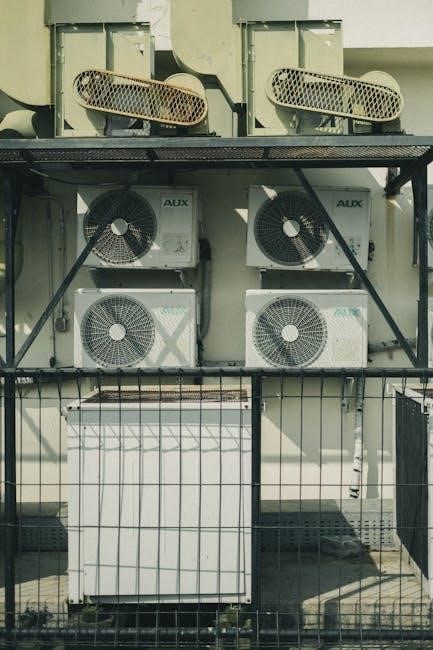
Mitsubishi Heavy Industries outdoor units house key components for heat rejection and compressor operation. The compressor circulates refrigerant, enabling cooling or heating. The condenser coil releases heat to the outside air, while the fan facilitates heat dissipation. Electrical components, including the capacitor and contactor, manage power distribution.
Additional parts include the expansion valve and refrigerant lines. Regular coil cleaning is vital for maintaining efficiency. Ensuring proper airflow around the unit is crucial. These components work in harmony to provide reliable climate control. Proper maintenance extends the lifespan of the outdoor unit.
Remote Control Overview
Mitsubishi Heavy Industries remote controls offer intuitive operation of your air conditioner. Key buttons include Power, Mode (Cool, Heat, Dry, Auto), Temperature Adjustment, and Fan Speed. The Timer function allows for scheduled operation, while Sleep Mode optimizes comfort during rest.
Airflow Direction control adjusts louvers for personalized cooling. The display shows current settings and status. Some models feature Energy Saving Mode. Proper battery replacement (following EU Directive 2013/56/EU guidelines) ensures continued functionality. Familiarize yourself with these features for optimal control.
Operating Instructions
To begin, ensure the unit is properly connected to power. Powering On/Off is achieved via the remote control or, in some cases, a local control panel. Select your desired Mode – Cool, Heat, Dry, or Auto – using the remote; Adjust the Temperature to your comfort level.
Fan Speed can be customized for airflow preference. Utilize the Timer for scheduled operation. Always consult your specific model’s manual (SRK63ZM-S, SRK10YN-S7, etc.) for detailed instructions. Following these steps guarantees efficient and comfortable climate control.
Powering On and Off
Initiating operation is typically done through the remote control; press the power button. Some models feature a local control panel for manual activation. To shut down, simply press the power button again. Ensure the unit completely powers off, indicated by the display turning off.
For safety, disconnect the power supply during extended periods of non-use. Refer to your specific model’s manual (like SRK63ZM-S or SRK10YN-S7) for precise instructions. Proper powering on and off procedures contribute to the longevity and efficient operation of your Mitsubishi AC system.
Mode Selection (Cool, Heat, Dry, Auto)
Mitsubishi ACs offer versatile modes accessed via the remote control. Cool mode lowers the room temperature. Heat mode provides warming functionality. Dry mode reduces humidity without significant temperature change, ideal for damp climates.
Auto mode intelligently selects cooling or heating based on the ambient temperature. Refer to your model’s manual (e.g., SRK63ZM-S, KX2 series) for specific mode operation details. Selecting the appropriate mode optimizes comfort and energy efficiency. Understanding these options ensures your system operates as intended;
Temperature Adjustment
Adjusting the temperature on your Mitsubishi Heavy Industries air conditioner is straightforward using the remote control. Typically, up/down arrow buttons control the set temperature. The display shows the desired temperature, usually in Celsius or Fahrenheit.
Models like SRK10YN-S7 allow precise temperature settings. Ensure the selected temperature is comfortable and energy-efficient. Refer to your specific model’s manual (RKW012A412D, KX2 series) for detailed instructions. Avoid extreme temperature settings for optimal performance and longevity of the unit.
Fan Speed Control

Controlling fan speed on your Mitsubishi Heavy Industries air conditioner is managed via the remote control. Options usually include Auto, Low, Medium, and High settings. The ‘Auto’ setting adjusts fan speed based on the temperature difference between the room and the set point.
Models such as SRK63ZM-S offer precise control. Lower speeds conserve energy, while higher speeds provide quicker cooling or heating. Consult your user manual (RKW012A412D, KX2 series) for specific instructions. Proper fan speed selection enhances comfort and optimizes energy efficiency.
Advanced Features
Mitsubishi Heavy Industries air conditioners boast several advanced features for enhanced comfort and efficiency. Timer functions allow scheduled on/off operation, optimizing energy use and convenience. Sleep Mode gradually adjusts temperature during the night for restful sleep.
Energy Saving Mode minimizes power consumption without sacrificing comfort. Airflow Direction Control lets you customize ventilation, directing air where needed. Refer to your specific model’s manual (SRK10YN-S7, KX2-RCD-HKX-S-E2, RKW012A412D) for detailed instructions on utilizing these features.
Timer Function (On/Off)
Mitsubishi Heavy Industries air conditioners offer versatile timer settings for automated operation. The On-Timer allows you to schedule the unit to start at a specific time, pre-cooling or pre-heating your space. Conversely, the Off-Timer sets a time for the unit to automatically shut down.
These features, detailed in manuals for models like SRK63ZM-S and RKW012A412D, enhance convenience and energy savings. Programming is typically done through the remote control. Consult your user manual (KX2-RCD-HKX-S-E2 series) for precise instructions tailored to your specific model.
Sleep Mode Operation
Mitsubishi Heavy Industries air conditioners feature a Sleep Mode designed for comfortable nighttime operation. This mode gently adjusts the temperature during sleep, preventing excessive heating or cooling. Typically, it gradually increases (cooling) or decreases (heating) the set temperature over several hours.
Refer to your specific model’s manual – such as those for SRK10YN-S7 or RKW012A412D – for detailed settings. Sleep Mode aims to maintain a pleasant sleep environment while optimizing energy efficiency. The KX2 series manual also provides insights into this feature’s functionality.
Energy Saving Mode
Mitsubishi Heavy Industries air conditioners often include an Energy Saving Mode, designed to reduce power consumption without significantly compromising comfort. This mode intelligently adjusts cooling or heating output based on room conditions and usage patterns. Consult your user manual – for models like SRK63ZM-S or the KX2-RCD-HKX-S-E2 – to understand specific settings.
The SRK10YN-S7 series manual details how this mode optimizes performance. It may involve slight temperature adjustments or fan speed control. Utilizing Energy Saving Mode contributes to lower electricity bills and a reduced environmental impact, enhancing the overall efficiency of your system.
Airflow Direction Control
Mitsubishi Heavy Industries air conditioners offer versatile Airflow Direction Control, allowing users to customize how air is distributed throughout the room. This feature, detailed in manuals for models like the SRK63ZM-S and KX2-RCD-HKX-S-E2, typically includes horizontal and vertical louver adjustments.
The SRK10YN-S7 series manual explains how to direct airflow upwards, downwards, or keep it stationary. Some units offer a “wide” airflow setting for broader coverage. Precise control enhances comfort by preventing drafts and ensuring even temperature distribution. Refer to your specific model’s manual for detailed instructions and available options.
Maintenance and Cleaning
Regular maintenance is crucial for optimal performance and longevity of your Mitsubishi Heavy Industries air conditioner. User manuals, including those for the SRK63ZM-S and KX2-RCD-HKX-S-E2, emphasize the importance of Air Filter Cleaning. This should be done frequently – typically every two weeks – to maintain air quality and efficiency.
Additionally, periodic Coil Cleaning (both indoor and outdoor units) is recommended. The SRK10YN-S7 manual details these procedures. Proper cleaning prevents dust buildup and ensures efficient heat exchange. Remember to disconnect power before any maintenance. Consult your manual for specific cleaning instructions and safety precautions.

Air Filter Cleaning
Air filter cleaning is a vital maintenance task for Mitsubishi Heavy Industries air conditioners, detailed in user manuals for models like the SRK63ZM-S and SRK10YN-S7. Regular cleaning – ideally every two weeks – ensures optimal airflow and air quality. A clogged filter reduces efficiency and can strain the system.
To clean, gently remove the filter, vacuum off loose dust, then wash with mild detergent and water. Ensure the filter is completely dry before reinstalling. Refer to your specific model’s manual for detailed instructions and filter location. Consistent filter maintenance contributes to long-lasting performance.
Coil Cleaning (Indoor & Outdoor)
Coil cleaning, both indoor and outdoor, is crucial for maintaining the efficiency of your Mitsubishi Heavy Industries air conditioner, as outlined in the user manuals. Dirty coils restrict airflow and reduce cooling/heating capacity. Professional cleaning is recommended annually for the outdoor unit, while the indoor coil may require less frequent attention.
Before cleaning, disconnect power. Use a specialized coil cleaner (available at HVAC supply stores) and follow the product instructions carefully. Avoid bending the fins. Regular coil maintenance extends the lifespan of your unit and improves energy efficiency, benefiting models like the KX2-RCD-HKX-S-E2.
Remote Control Battery Replacement
Replacing the batteries in your Mitsubishi Heavy Industries air conditioner’s remote control is a simple process, ensuring continued operation. The user manual details this procedure, typically requiring two AAA or AA batteries (check your specific model – SRK63ZM-S, SRK10YN-S7, etc.).
Locate the battery compartment on the back of the remote. Slide the cover open and insert new batteries, matching the polarity (+ and -) indicated. Dispose of old batteries responsibly, adhering to EU Directive 2013/56/EU guidelines for chemical waste. A functioning remote is essential for controlling all features of your air conditioning system.
Troubleshooting Common Issues
This section addresses frequent problems with your Mitsubishi Heavy Industries air conditioner (models like SRK63ZM-S, SRK10YN-S7). Common issues include the unit not cooling or heating effectively. Check the air filter first – a clogged filter restricts airflow.
Refer to the error codes displayed on the unit; the manual provides explanations (e.g., E01, E02). Ensure proper power supply and remote control functionality. If problems persist, consult the full user manual or contact a qualified technician for assistance. Ignoring issues can lead to more significant repairs.
Air Conditioner Not Cooling

If your Mitsubishi air conditioner isn’t cooling, first check the air filter for blockage – a common cause. Ensure the thermostat is set to ‘Cool’ mode and the desired temperature is lower than the room temperature. Verify the outdoor unit isn’t obstructed by debris.
Inspect for ice buildup on the coils, which restricts airflow. Consult the error codes displayed; these can pinpoint the issue. If the problem persists, refer to the full user manual for model-specific troubleshooting or contact a qualified technician for repair.
Air Conditioner Not Heating
When your Mitsubishi air conditioner fails to heat, initially confirm it’s set to ‘Heat’ mode on the remote control, with a temperature higher than the room’s current temperature. Check the outdoor unit for obstructions like snow or ice, hindering operation. A frozen outdoor coil can also prevent heating; defrosting may be required.
Review the error codes displayed on the unit, as they offer valuable diagnostic information. Consult your specific model’s manual for detailed troubleshooting steps. If issues continue, professional service is recommended to diagnose and resolve the heating problem.
Error Codes and Their Meanings
Mitsubishi Heavy Industries air conditioners utilize error codes to signal malfunctions. These codes, displayed on the indoor unit, pinpoint the source of the problem, aiding in troubleshooting. Understanding these codes is crucial for efficient repair. Refer to your specific model’s manual for a complete list and detailed explanations.
Common codes, like E01 or E02, indicate specific issues – for example, sensor errors or communication failures. Ignoring error codes can lead to further damage. If you encounter an unfamiliar code, consult a qualified technician for assistance and proper diagnosis.
Understanding Error Codes
Mitsubishi Heavy Industries air conditioners employ a sophisticated error code system for diagnostics. These alphanumeric codes, displayed on the indoor unit, represent specific malfunctions within the system. Decoding these signals is vital for effective troubleshooting and repair. Each code corresponds to a particular issue, ranging from sensor failures to refrigerant leaks.
Consulting the user manual is paramount; it provides a comprehensive list of error codes and their corresponding meanings. Ignoring these codes can exacerbate problems and lead to costly repairs. Professional assistance is recommended for complex or unfamiliar error messages.
Specific Error Code Explanations (e.g., E01, E02)
Error code E01 typically indicates an issue with the indoor unit’s temperature sensor, potentially leading to inaccurate temperature readings or system malfunction. Code E02 often signals a problem with the outdoor unit’s temperature sensor, impacting cooling or heating performance. E03 frequently points to a communication error between the indoor and outdoor units.
These are just examples; the manual details numerous other codes. Always refer to your specific model’s manual for accurate interpretations. Attempting repairs based on generalized information can be detrimental. Professional diagnosis is crucial for resolving complex error code issues effectively.
Battery Disposal Information (EU Directive 2013/56/EU)
This product’s remote control utilizes batteries. EU Directive 2013/56/EU mandates separate disposal of batteries from general household waste. Do not discard batteries with regular trash. Look for designated collection points in your community for battery recycling.
If a chemical symbol (like Hg, Cd, or Pb) appears beneath the battery symbol, it indicates the presence of heavy metals above certain concentration thresholds. Proper disposal prevents environmental contamination and promotes resource recovery. Follow local regulations for battery recycling and disposal procedures.
Downloading User Manuals
Accessing your Mitsubishi Heavy Industries air conditioner’s user manual is straightforward. Online resources provide convenient downloads in PDF format. Visit the Mitsubishi Heavy Industries website to locate manuals specific to your model number – such as SRK63ZM-S or KX2-RCD-HKX-S-E2.
Browse the support section and utilize the search function to quickly find the correct documentation. Downloaded manuals offer detailed instructions on operation, maintenance, and troubleshooting. Ensure you have the latest version for accurate information and optimal performance of your air conditioning system.
Locating Manuals Online
Finding Mitsubishi Heavy Industries air conditioner manuals online is simple. Start at the official Mitsubishi Heavy Industries website; navigate to their support or downloads section. Utilize the search bar, entering your specific model number – for example, SRK10YN-S7 or RKW012A412D – for precise results.
ManualsLib is another valuable resource, offering a collection of user guides for various Mitsubishi models. Ensure the manual matches your unit to avoid incorrect information. PDF downloads are readily available, providing comprehensive instructions for operation and maintenance.
Mitsubishi Heavy Industries Website Resources
The Mitsubishi Heavy Industries website is the primary hub for air conditioner documentation. Explore the “HVAC” or “Air Conditioning” sections to locate dedicated support areas. Downloadable PDF manuals are categorized by product type – split systems, packaged units, and more – simplifying your search.
Access detailed specifications, technical drawings, and troubleshooting guides alongside user manuals. Register your product for access to exclusive content and updates. Frequently Asked Questions (FAQs) address common issues, offering quick solutions. Contact customer support directly through the website for personalized assistance.
Packaged Air Conditioner Specifics
Mitsubishi’s packaged air conditioners, like the KX2 ー RCD-HKX-S-E2 series, integrate all components into a single unit for simplified installation. User manuals for these systems detail unique features, including advanced controls and diagnostics. Refer to the manual for specific wiring diagrams, maintenance schedules, and troubleshooting steps tailored to packaged units.
Understanding the indoor and outdoor unit interactions is crucial for effective operation. The manual provides guidance on airflow adjustments, refrigerant charge checks, and filter replacement procedures. Always consult the manual before attempting any repairs or modifications to ensure safety and maintain warranty validity.
KX2 ー RCD-HKX-S-E2 Series Information
The Mitsubishi KX2 ౼ RCD-HKX-S-E2 series represents a range of packaged air conditioning solutions designed for efficient and reliable climate control. Dedicated user manuals provide in-depth information on installation, operation, and maintenance specific to these models. These resources detail the unique features of the series, including advanced control systems and energy-saving modes.
Users can access detailed diagrams illustrating component locations and wiring configurations. The manual also outlines troubleshooting procedures for common issues, aiding in quick and effective problem resolution. Properly utilizing this documentation ensures optimal performance and extends the lifespan of your KX2 unit.
Split-System Air Conditioner Manuals
Mitsubishi Heavy Industries offers a comprehensive collection of user manuals for its split-system air conditioners. These manuals, available for download, cover a wide range of models, including the popular SRK10YN-S7, SRK13YN-S7, and SRK18YN-S7 series. Each manual provides detailed instructions on installation, operation, maintenance, and troubleshooting.
Users will find clear explanations of features, remote control functions, and error codes. Accessing the correct manual is crucial for maximizing the performance and longevity of your split-system unit. These resources empower owners to effectively manage their air conditioning systems and address potential issues.

SRK10YN-S7, SRK13YN-S7, SRK18YN-S7 Series
These Mitsubishi Heavy Industries air conditioner series – SRK10YN-S7, SRK13YN-S7, and SRK18YN-S7 – share similar functionalities but differ in cooling capacity. The user manual for these models emphasizes careful reading before operation to ensure optimal, long-lasting performance. It details everything from initial setup and remote control usage to advanced features like timer and sleep modes.
Owners will benefit from understanding the troubleshooting section, addressing common issues and interpreting error codes. Proper maintenance, including air filter cleaning, is also highlighted. Downloading the specific manual for your model guarantees access to accurate and relevant information for your unit.
Warranty Information
Mitsubishi Heavy Industries air conditioners are backed by a comprehensive warranty, details of which are typically found within the specific product’s user manual. Warranty coverage generally includes defects in materials and workmanship for a defined period, varying by model and region. Registration of your air conditioner is often required to activate the full warranty benefits.
The manual outlines the process for submitting warranty claims, including required documentation and authorized service centers. Keep your proof of purchase and the warranty card readily available. Understanding the terms and conditions ensures you can effectively utilize the warranty should any issues arise during the coverage period.